Thermal Haptics for Fire Simulation :
Radiative and Convective Heat Transfer Model from Fire Dynamics Data
DURATION
2023.05 - Present
2 years 8 months
(ongoing)
KEY WORDS
VR
Simulation
RESEARCH
Thermal haptic
Contribution
Team Leader
Engineering
Design Research
CO-WORKER
Jiyoon Lee
Sungmo Lee
Nahyun Lee
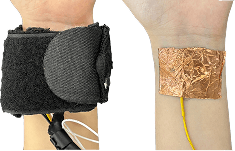
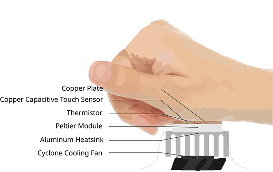
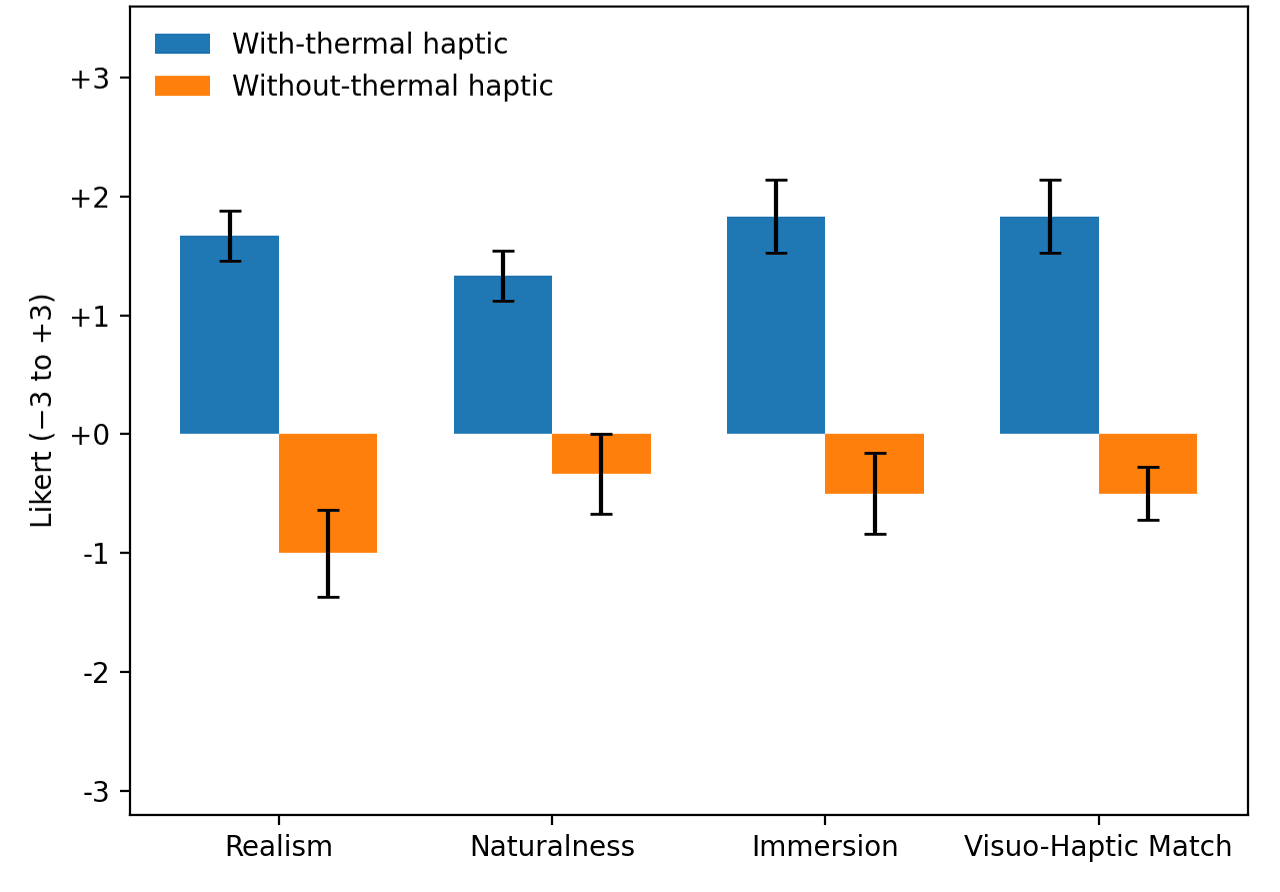
This work present a framework that provides users with thermal haptic feedback through a fire training simulation driven by fire dynamics data. Simulations based on fire dynamics data have great potential to reproduce highly realistic fire scenarios. Previous research has primarily focused on enhancing real-time visual realism, whereas attempts to integrate thermal feedback have been relatively limited. Proposed model incorporates fire dynamics data to approximate real-time convective and radiative heat transfer.
Independent Research
|
2023.05 ~ 2023.01
Reference
Hoseok Jung, Jiyoon Lee, and Hyunimin Kang. 2025. Thermal Haptics for Fire Simulation: Radiative and Convective Heat Transfer Model from Fire Dynamics Data. In Proceedings of IEEE International Symposium on Mixed and Augmented Reality (ISMAR ‘25). (Research demonstration). DOI: [https://doi.org/10.1109/ISMAR-Adjunct68609.2025.00305]
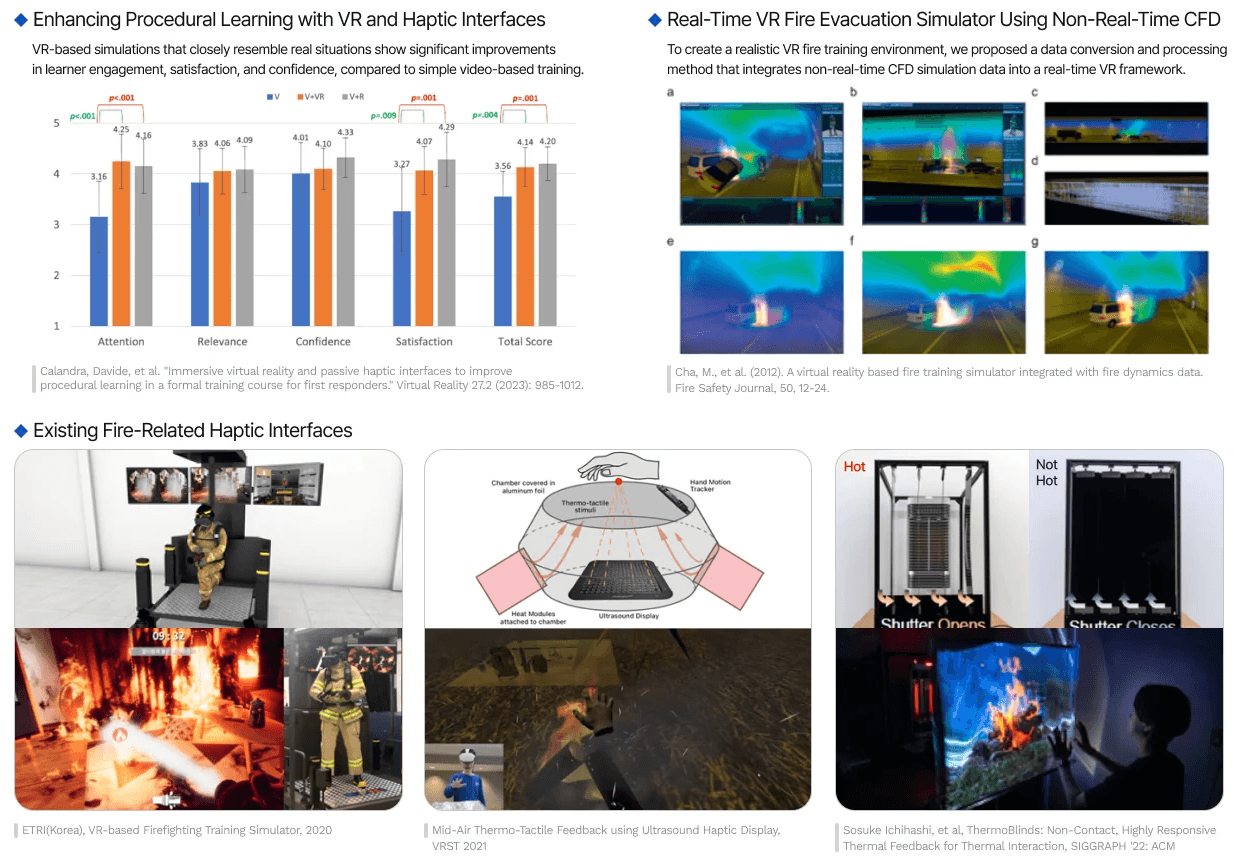
The importance of realistic fire simulation
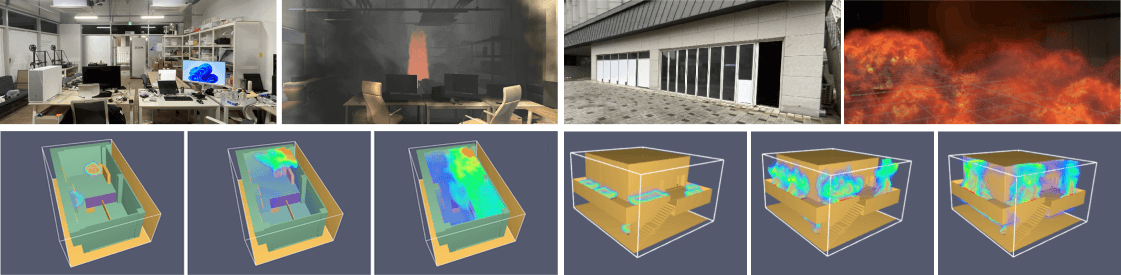
Fire Dynamics Data Generation and Pre-processing
Getting environment data and fire simulation data
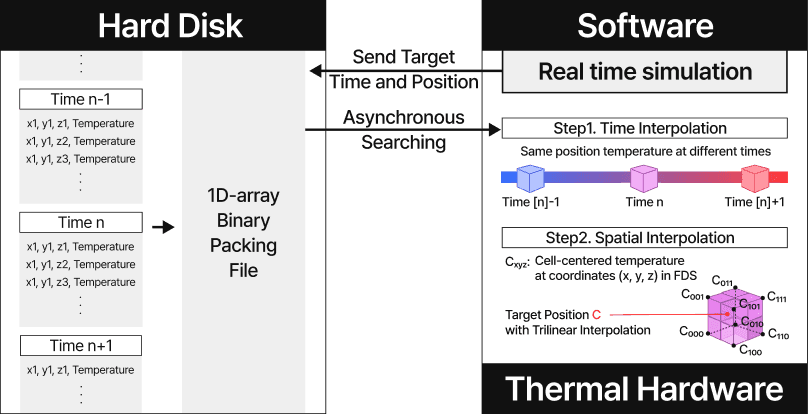
Pre-processing Data Flow
Fire Dynamics Data-Based Thermal Interaction Model
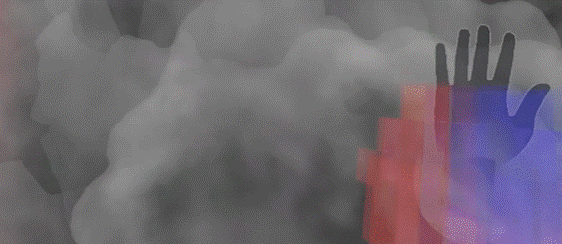
Convective Heat Transfer
Sample ambient air temperature Tₑₙᵥ at the user’s position from FDS (with temporal interpolation) read skin temperature Tₛₖᵢₙ from a sensor
Compute the convective heat flux via Newton’s law of cooling, q = h (Tₑₙᵥ − Tₛₖᵢₙ)
Update q every frame and feed it to the thermal renderer
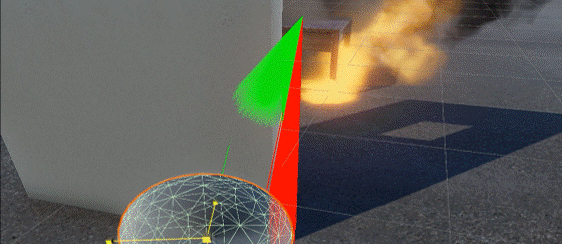
Thermal Radiation Transfer
Interpolate the time‑varying radiative power from FDS and uniformly place Lambertian point emitters within the fire region
Cast Monte Carlo rays within the solid angle subtended by the skin receiver (with the haptic device attached)
Convert deposited energy from rays to radiative heat flux at the skin and pass it to the renderer
Thermal Rendering
Sum convective and radiative fluxes to obtain the target thermal stimulus q
Use the Ho & Jones thermal contact model to compute the target display temperature, given current skin/display temperatures and contact resistance
Drive the thermal display to track this target in real time and deliver the sensation